


Past events
J-Lens series: Perspectives of Japan Vol. 3
“Tracing the Path to Becoming ‘Human’ Through the Tail:
An Invitation to Shippology”
by Dr. Tojima Sayaka

1. Hanoi
| [Date time] | Saturday, March 28, 2026
10h00 – 12h00 |
| [Venue] | Room G106, University of Social Sciences and Humanities, VNU-HN
(336 Nguyen Trai, Thanh Xuan Ward, Hanoi) |
| [Registration] | Free. Pre-register at https://tinyurl.com/shippology-hanoi |
2. Ho Chi Minh City
| [Date time] | Sunday, March 29, 2026
9h30 – 11h30 |
| [Venue] | Room D.201-202, University of Social Sciences and Humanities, VNU-HCM
(10-12 Dinh Tien Hoang, Sai Gon Ward, HCM city) |
| [Registration] | Free. Pre-register at https://tinyurl.com/shippology-hcm |
* Lecture in Japanese with Vietnamese interpretation
Recommended for audiences over 13 years old, as the lecture includes academic content
[J-Lens series: Perspectives of Japan – Vol. 3]
What Can the Lost Tail Teach Us About Humans?
An Introduction to Shippology (tail studies)
The Japan Foundation Center for Cultural Exchange in Vietnam is pleased to present the lecture “Tracing the Path to Becoming ‘Human’ Through the Tail: An Invitation to Shippology” by Dr. Sayaka Tojima, Assistant Professor at the Kyoto Institute of Technology.
Among primates, humans are distinctive in lacking a tail—an anatomical feature that was present in our distant evolutionary ancestors. While the disappearance of the tail may seem like a minor detail in human anatomy, it raises a fascinating question: why and how did humans lose their tails, and what can this tell us about the process of becoming human?
At the same time, the idea of the tail has persisted vividly in human imagination. Across cultures and historical periods, myths, folklore, and historical records have described “tailed humans”. One of the oldest known accounts appears in Nihon Shoki, Japan’s oldest historical chronicle, which includes descriptions of people said to have had tails. These recurring images suggest that the tail continues to hold symbolic and cultural meaning even after its biological disappearance, and invite us to reflect on why a body part lost in evolution continues to capture human curiosity and creativity.
In this lecture, Dr. Tojima introduces her interdisciplinary research approach known as “Shippology”—a field that examines the tail from both biological and humanistic perspectives. Drawing on evolutionary biology and developmental science, she explores how and when the human lineage lost its tail, including insights from embryonic development and comparative anatomy. At the same time, she considers how the concept of the tail has been represented in historical texts, myths, and cultural narratives.
By bringing together scientific and cultural perspectives, the lecture invites audiences to reconsider the question of what it means to be human. Through the lens of the “lost tail,” participants will explore how biological evolution, historical imagination, and cultural expression intersect in shaping our understanding of human identity.
What is the “J-Lens: Perspective of Japan” series?
J-Lens explores Japan through diverse intellectual “lenses,” offering new ways to understand its culture, society, and history.
Rather than presenting facts alone, each session shows how scholars ask questions and conduct research within their fields. Through these perspectives, audiences are invited to rethink culture, society, and humanity in fresh and engaging ways.
For inquiries on the lecture and speaker interview, please contact:
The Japan Foundation Center for Cultural Exchange in Vietnam
27 Quang Trung, Cua Nam Ward, Hanoi, Vietnam
Ms. Ánh 024-3944-7419 (ext.136) / Mr. Osuka 024-3944-7419 (ext.140) / Mr. Kaneko 024-3944-7419 (ext.127)
https://www.facebook.com/japanfoundation.vietnam/ https://hn.jpf.go.jp/
(for lecture in Hanoi)
VNU-HN, University of Social Sciences and Humanities
336 Nguyen Trai, Thanh Xuan Ward, Hanoi
https://ussh.vnu.edu.vn/ contact@ussh.edu.vn
(for lecture in HCM city)
VNU-HCM, University of Social Sciences and Humanities
10-12 Dinh Tien Hoang, Sai Gon Ward, HCM City
https://hcmussh.edu.vn/ hcth@hcmussh.edu.vn
■ Credit
Organizer: The Japan Foundation Center for Cultural Exchange in Vietnam
In collaboration with: (VNU-HN, VNU-HCM) University of Social Sciences and Humanities
■ Speaker’s information
Assistant Professor TOJIMA Sayaka
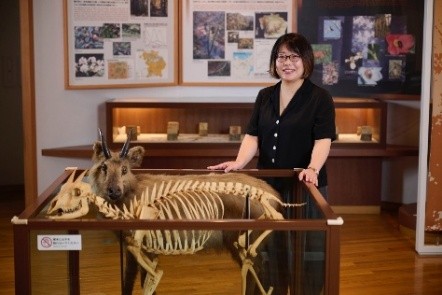
Division of Applied Biology, Kyoto Institute of Technology
Born in Osaka Prefecture in 1986. She received her B.A. (Literature) from Nara Women’s University, Faculty of Letters, where she studied zooarchaeology. She then received her PhD (Science) from the Graduate School of Science, Kyoto University in 2014.
After a three-years fellowship at the Laboratory of Developmental Biology, Graduate School of Science, Kyoto University, she became an Assistant Professor at the Department of Anatomy and Cell Biology, Graduate School of Medicine, Osaka City University, in 2017. In October 2021, she moved to Kyoto University’s Hakubi Center for Advanced Research, which fosters promising young researchers, and moved to current university in April 2025.
She is exploring how humans lost their tails through an evolutionary and developmental biology approach, while also analyzing historical depictions of tails to trace changes in human-specific cognition. She emphasizes the importance of thinking from diverse, open perspectives beyond traditional disciplines and calls her diverse research approaches “Shippology” (from “shippo,” meaning “tail” in Japanese).
Main publications:
“Shippology” (Kobunsha, 2024)
“Archaeology for 13-Year-Olds: Why Don’t Humans Have Tails? The Story of Two Losses” (Shin Sensha, 2025)

